The importance of setting

At first sight, Snowpiercer makes little sense. Some time in the near future, mankind has hit upon a solution to global warming which involves shooting a substance called CW-7 into the upper atmosphere so as to reduce the intensity of sunlight reaching the surface. Unfortunately this goes horribly wrong and the outside temperature plummets to minus 120 degrees Fahrenheit.

But thankfully Joseph Wilford, CEO of Wilford Industries, has built Snowpiercer, a train 1,001 cars long that circles the globe every 133 days on a track 318,000 km long. It is powered by a Perpetual Motion Engine, no less, which means that it can never stop. Indeed at one point slowing by a mere 12 percent results in severe blackouts as the batteries drain. Continue reading →

That Nazi salute

Like a lot of people these days, I’m spending far too much time watching Netflix. There is a lot to enjoy, but one series that has stood out for me is The Chair.

This takes place in the somewhat decrepit English department of Pembroke University, a fictitious establishment that looks to be located in New England. Professor Ji-Yoon Kim, played by Sandra Oh of Killing Eve fame, has been appointed chair. She is the first woman to hold that position. Student numbers are down and attendance for some of the lectures is in single figures.

The whole story is told in just six half-hour episodes, but it still manages to explore weighty issues around freedom of expression, the nature of truth and the dangers of social media. I’d like to deal with just one plotline here, and I should warn you there a spoilers ahead, so don’t read on if you intend to watch the series.

Continue reading →

Dodgy decisions

So, according to a Channel 4 investigation, some 45% of the 2009 national pandemic stockpile was past its use-by date by the time COVID-19 was declared a national pandemic on 30 January 2020. Some 200 million respirators, masks, syringes and other vital kit were officially unsafe, despite many attempts to pretend otherwise by extending those use-by dates, often repeatedly.

Expiry dates are nothing new, and anyone designing a national pandemic stockpile would, or should, have been aware that items within it would expire as the years passed. I’m no expert but I would imagine that a sensible process would be to distribute items to the NHS from the stockpile as they approach their use-by dates, and then replenish the stockpile with new items.

It’s hardly rocket science, but when there is a public enquiry into the government’s handling of COVID-19 (and there better be one), I would very much like to know exactly what its policy was for insuring the stockpile was kept up to date.

Perhaps more frightening is that someone thought it was OK to extend those use-by dates, and instructed a whole load of people to do so. In the UK, and indeed throughout the civilised world, it is an offence to change the use-by dates on food. I’m not looking for a prosecution here, but I sure would like that person to stand up and explain their reasoning in public. And then I would like to know that they will never work in public service again.


Misleading language on COVID-19

On 2 April our Secretary of State for Health Matt Hancock set out a target of “100,000 [COVID-19] tests per day” by the end of the month. Right from the start this seemed ambitious, and as we approach the end of the month it is widely thought to be unatainable. However Matt Hancock and his colleagues persist, insisting even today that they will “have the ability to carry out 100,000 tests a day” by the end of the month.

But note how the language has changed. Most of us assume that, for Hancock’s target to be achieved, 100,000 people will be tested each day from tomorrow (30 April) onward. We assume that Hancock is using the word ‘tests’ as a verb; an action that is carried out on a person. However, in its more recent incarnation, the word is being used as a noun in that ‘tests’ now refers to the kit that is needed to carry out the test, rather than the actual act of testing.

The government may well be able to supply 100,000 test kits each day, but unless the staff and the facilities exist to administer those tests in a safe and relatively convenient manner, the target is meaningless. According to the government website, the intention is to open 48 drive-through testing stations by the end of the month, and there is a 37-page document explaining how to arrange a test. As if to prove the point, the government is claiming a capacity of 75,000 tests a day, but less than 20,000 people are actually being tested. I even heard someone put this down to a ‘lack of demand’ which is disingenuous to say the least.

We are used to such smoke-and-mirror tricks from the private sector, and they were succesfully deployed to undermine much that was meaningful in the Brexit debate. However right now the government needs us to trust them more than ever. It’s time to ignore the spin-doctors and start talking straight.


Why am I writing a novel?

Foyles front desk

Dreams of being front desk at Foyles.

Someone once said, “Everyone has a book inside them.” That may be the case, but it’s a fairly meaningless statement. You could equally claim “Everyone has a painting inside them,” and indeed, if someone left me for a couple of hours with a paint set and some blank sheets of paper I could probably produce something that would at least give me some satisfaction, and might even elicit a few “That’s nice” comments from friends and family. However the chances of it ending up on a wall in the Royal Academy are pretty small. That’s not the point: the point is that I had some fun doing it, and perhaps learnt a few things about myself and about the world along the way.

Many set out on the path of writing a novel in a similar vein. However at some point, perhaps a few months or a few tens of thousands of words later, the enormity of the task dawns. My father, who’s work did once decorate the walls of a Summer Exhibition at the Royal Academy, could knock out a couple of paintings in an afternoon. By contrast, unless you are exceptionally talented, or have a great deal of spare time, it’s likely to be several years before your novel reaches a state that could remotely be described as “finished” in the sense that you have a manuscript of perhaps 70 or 80,000 words that, after several revisions and even rewrites, you really believe is the best you can make it. Continue reading →

Back to the future with Brexit

lighthouseRecent events have brought to mind an old joke that goes something like this. It involves two vessels approaching each other on a collision course:

“Please make way! You are obstructing our passage through the open seas.”

“Regretfully we are unable to comply. I’m afraid it is you that must make way.”

“We are a battleship of Her Majesty’s Royal Navy! We represent the glorious British Empire and all who sail in her! Brexit means Brexit! You must make way immediately!!”

“We are a lighthouse.”

I understand that Dominic Raab and Michel Barnier have at last cobbled together a trade deal that has proved, after a somewhat fraught five-hour meeting, acceptable to the cabinet. There will inevitably be some hiccups on the way (such as the resignation of said Raab, announced as I write) but it seems to me that its future course can be mapped out with some confidence. Continue reading →

Was Albert Einstein antisemitic?

albert-einstein-1144965_640In 1948, the renowned scientist Albert Einstein co-authored an open letter to the New York Times expressing his concerns about the visit to America of Menachem Begin, leader of the Freedom Party in the newly-formed state of Israel. Earlier that year, Begin had been involved in the massacre of an Arab village which had shocked the world, including most in the Jewish community. In the letter, Einstein describes the Freedom Party as “a political party closely akin in its organization, methods, political philosophy and social appeal to the Nazi and Fascist parties.” Begin went on to become Prime Minister of Israel in 1977 and remained in power until 1981.

Things are different now, which is perhaps why the 10th example given in the Working Definition of Antisemitism developed by the International Holocaust Remembrance Alliance (IHRA) sites “Drawing comparisons of contemporary Israeli policy to that of the Nazis.” Einstein was not only a Jew but also a Zionist, although he resisted “the idea of a Jewish state with borders, an army, and a measure of temporal power.” Nevertheless, if such a statement was to be made now, then the IHRA suggests it be branded antisemitic. Continue reading →

Labour must refute charges of anti-Semitism

Misuse of anti-Semitism 2Is it anti-Semitic to accuse rich bankers of living off the backs of the poor? Or to condemn the Israeli government for its treatment of the Palestinians, or indeed the Lebanese? I don’t think so, and one reason I support the Labour Party is for its robust condemnation of these things. However it is anti-Semitic to suggest those bankers are necessarily Jewish, or that the activities of the Israeli government are necessarily endorsed by all Jews, and I find it disturbing that the Labour party seems unable to distance itself from such views.

There is a long history of anti-Semitism in British politics, both on the left and on the right, but it has no place in the modern world, and no relevance to the central message of Jeremy Corbyn’s new Labour Party. And yet, for some reason, Corbyn seems unwilling to shrug it off with any real conviction. Continue reading →

Brexit madness (2)

You can learn an awful lot about Brexit from chlorinated chicken.
The term itself refers to the process of dipping fresh chicken carcasses into water containing chlorine dioxide just prior to packaging in an effort to kill off any potentially dangerous organisms such as E. coli or Salmonella that might be present. It is a process that is legal in the United States, but not permitted within the European Union where farmers are allowed to wash raw meat in precious little other than fresh water. For this reason it is not permissible to import fresh chicken from the US into the EU. Continue reading →

Hiveword Novel Organizer

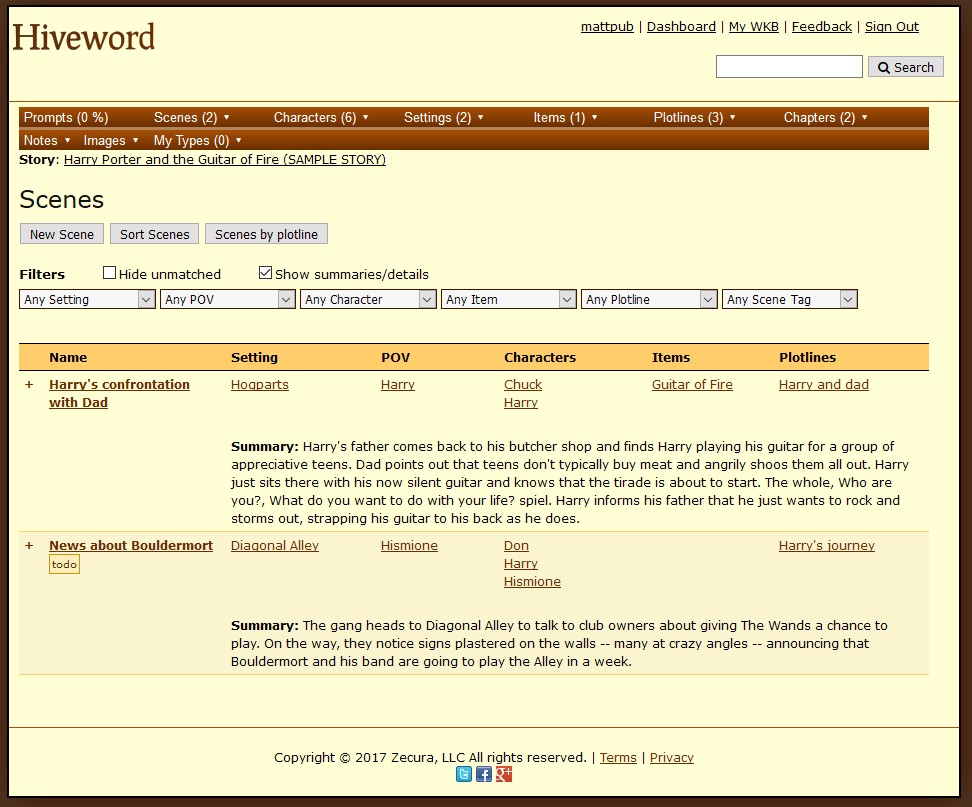
hivewordSome writers seem able to bash out a novel unaided, holding all the pieces in their head as they write their way through every plot twist to a satisfying and consistent climax. For the rest of us there are a plenty of tools that can offer a helping hand, ranging from hastily scribbled notes stuck on a convenient wall to more sophisticated solutions such as Power Structure, StoryWeaver or Scrivener. Having tried a number of these, I find myself increasingly drawn to Hiveword.

Hiveword Novel Organizer, to give its full title, is an on-line database for recording and displaying the structural elements of your story, namely its Characters, Settings, Items (such as magic rings or significant documents), Plotlines and Scene progression. The details of these elements are recorded on forms and can be displayed in Lists. Continue reading →