
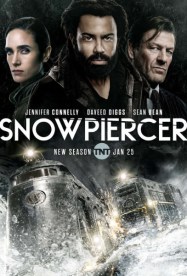
At first sight, Snowpiercer makes little sense. Some time in the near future, mankind has hit upon a solution to global warming which involves shooting a substance called CW-7 into the upper atmosphere so as to reduce the intensity of sunlight reaching the surface. Unfortunately this goes horribly wrong and the outside temperature plummets to minus 120 degrees Fahrenheit.
But thankfully Joseph Wilford, CEO of Wilford Industries, has built Snowpiercer, a train 1,001 cars long that circles the globe every 133 days on a track 318,000 km long. It is powered by a Perpetual Motion Engine, no less, which means that it can never stop. Indeed at one point slowing by a mere 12 percent results in severe blackouts as the batteries drain.
Originally envisaged as a luxury dreamliner experience, it becomes salvation for the lucky 2,600-odd ticket holders, and the 400 or so ‘Tailies’ who force their way on board as it departs, despite the best efforts of Wilford’s security force, known as Jackboots, to stop them. The illegals are known as ‘Tailies’ because they live in the last three cars at the tail of the train, which were originally intended for cargo.
Immediately behind the Engine itself is the First Class section with accomodation and dining cars, together with The Aquarium and Sushi Bar, the Sauna, the Aviary and the Gallery, which contains masterpieces by Rembrandt and the like. Select families have whole carriages to themselves. There is also a car for Hospitality who strut around in their teal uniforms performing a hostess role and acting as ‘The Voice of The Train’ when announcements are needed.
This is followed by Second Class which is inhabited by doctors, teachers and other white-collar professionals. At its far end is the Night Car which started out as a brothel but is now more of a high-class night club cum therapy centre. The Third Class section begins with the Border Car and contains Greenhouse, Cattle, Goat, Chicken and Aquaculture Cars which supply the food, together with Water Cars, Classroom Cars for the children, Market Cars which function like bazaars, and Battery Cars which are kept topped up by the Engine. There are also Jackboot and Brakemen Garrison Cars.
Just this short description is enough to suggest numerous plots, particularly given the precarious nature of the environment. Puncture a Greenhouse or a Cattle Car and its contents are lost forever. Disconnect a carriage and anyone down-train freezes to death within seconds. As you would expect, revolution is in the air and there are calls to uncouple the Tailies. It is indeed a microcosm of our own universe, as the box-set in particular amply demonstrates.
Snowpiercer has been around for some time. It first appeared in a French graphic novel published in 1982 but had to wait over 30 years to be adapted into a film in 2013 and then finally into a two-series box set in 2020 and 2021, with a third series on the way. I am not familiar with the graphic novels, although they’ve had positive reviews, but it’s in the box set that the environment really comes into its own.
Set a novel in the real world and your setting has its own geography and a history established long before you came along. If you’re lucky you might allow a few readers to see aspects of that world in a different light, but it is not your property. However set a novel in an imaginary world that is rich and well-planned and that world becomes irreversibly associated with your work, as Middle Earth is with Lord of the Rings, or Panem with The Hunger Games.


