
This is a longer story that I finished in 2020. I was advised that it was too long for a short story and written too much like a novel, so I shelved it. However, I still think it has some merit, so here it is:
Peter has no desire to remain in the offices of Frobisher & Frobisher any longer than necessary. It’s not that he actively dislikes the man facing him across the unduly large leather-topped desk, incongruous against the featureless beige walls and cheap brown carpet. It is more to do with the party he represents.
Cavendish Frobisher shifts uncomfortably in his fake leather chair. “I appreciate that relations with your father have been somewhat intermittent in recent years, but you should know that he held you in high regard, right up to the end.”
Given that Peter has not seen his father since the end of World War II some thirty years ago, ‘intermittent’ is something of an understatement. Over the intervening decades Peter has built up a successful business of his own. He owes his father nothing and he felt nothing but relief on learning of his father’s death. He only attended the funeral to prove to himself that the man was finally gone. Even then he had stood back, not wanting to interact with the handful of stern but somewhat pathetic old men standing around the grave casting surreptitious glances at each other and back at himself. It had been a sodden, grey affair under a rain-bearing sky, and when one of them turned to make an approach, he quickly departed. He had no idea who any of them were, and no desire to find out.
Cavendish glances down at the document that lies open on the desk in front of him and coughs. Peter returns his gaze impassively.
“Yes, well. His will is fairly straightforward. As his only son and heir, he has left the bulk of his estate to you. The remainder he has specified should go to a number of, well, shall we call them charities? We needn’t go into the details. Suffice to say that you inherit his house and all its contents.”
Peter sighs. He has no need or interest in his father’s nondescript suburban semi or anything it might contain. He will instruct his secretary to arrange clearance and that will be an end to it.
Cavendish looks embarrassed at the lack of reaction, stares intently at a row of cheap metal filing cabinets, and then back at the document. He turns the page and scrutinises its contents as though reading it for the first time.
“However, there is one more item.” He looks back up at Peter who nods impatiently for him to continue.
“Yes, well. There is, apparently, an item that you need to collect personally. It will be necessary for you to go to this address to collect it.”
Cavendish slides a handwritten note across the table. It contains an address in West Berlin, and a name.
“Is this really necessary? Can’t this ‘Heinrich Muller’ simply courier the item to me, here in London?”
“Apparently not. Your father is most specific. You will need to go to Berlin to collect it. Herr Muller will only hand the item over directly to you in his office, where it currently resides.”
“OK, but what is this object anyway?”
For the first time since Peter entered the office, Cavendish smiles. It is a small emotionless grimace, barely a flicker of the lips, but it is a smile.
“I have no idea, Peter. If you want an answer to that question, you will have to go to Berlin.”
oOo
Rebecca looks around the room at the friends and the few surviving relatives that have gathered to honour her grandmother’s life. There is of course aunt Mimi, in whose house the event is being held, and there are a couple of cousins whom she recognises but barely knows. Almost everybody else is of her grandmother’s generation: presumably friends she made after they settled in London.
Rebecca was born a few years after the end of World War II. By that time most of her family were lost or scattered. This is the first Jewish funeral she has attended and she isn’t quite sure what is expected of her. She had spent much of the afternoon working out what to wear and in the end gone for a short-sleeved black lace dress that she now regrets. The table is overflowing with gifts of food and drink alongside the various cakes that Mimi has made for the occasion, so she makes her way over and places a few of the more delicious-looking delicacies on a plate.
The history of her family is something she has pieced together over the years from desperate moments of recollection recounted to her by surviving members of her family. There was also that time in her teens when her parents sat her down and sketched in the bare bones, touching lightly on those periods of extreme suffering but deeply enough for her to know it is a darkness that will hang over her and her family, and thousands upon thousands of other families, forever.
She learned that her parents both survived the Sachsenhausen concentration camp, although they had not known each other at the time. Following liberation her father intended to travel to Israel but was persuaded by a friend to visit London. It was there that he met her mother and they settled and built a life that, at least while it lasted, was comfortable and secure.
Her grandfather had been picked up by the Gestapo in the street outside their home in Berlin shortly after the start of the war and disappeared. In desperation her grandmother had grabbed Mimi, who was five at the time, and they had made their way first to France and then to America where they settled in New York. Once the war ended they joined what remained of their family, including her parents, in England.
Her aunt is in conversation with one of the cousins so Rebecca makes her way over to the mantlepiece on which stands the obligatory red candle and a number of black-and-white framed photographs. She is studying these and picking at her food when her aunt comes over.
“She was a beautiful woman, wasn’t she?” Mimi nods towards one of the photographs which depicts her grandmother in her forties, about the same age as Mimi herself. She is sitting on a park bench watching a young child playing in bright sunlight on the grass near her feet. She is smiling at the camera and behind her trees and buildings rise high into the sky.
“Yes, she was. Is that you, playing on the grass?”
“That’s right. It was taken in Central Park, shortly after we arrived in America.”
“That must have been quite something.”
“It was wonderful. Safe at last!” Mimi laughs at the memory of it and turns to Rebecca. “But how are you doing? You’re looking wonderful as always, and that dress does look good on you so you can stop worrying. But what is going on in your life? Is there anyone special in it yet …?”
She adopts a sorrowful expression, but her eyes are sparkling so Rebecca knows she’s not being serious.
Rebecca laughs to hide her blush, “No there isn’t! But that’s just fine with me. I’m quite busy enough, what with the lecturing and the PhD. And I’ve just moved in to a new flat just round the corner from the college.”
“You’re just so clever, aren’t you! Your grandmother would have been so proud of you … was so proud of you.”
Rebecca deflects Mimi’s attention towards another picture. This one shows her grandmother looking younger still, wearing a flamboyant dress with one hand resting on a marble mantlepiece bearing an extravagant antique mantel clock and an assortment of ornaments.
“So where is this?”
“Ah, now, that’s the house we lived in before the war, before the Nazis came.”
“The house in Berlin?”
“That’s right. I don’t remember much of it: after all, I was only five when we left. If you’re interested, there’s some more pictures in here.”
She picks up a tattered photo album from a side table and holds it open for Rebecca to see, “I put this together yesterday. She had all these boxes full of photos and old letters so I thought I’d sort through them.”
Mimi indicates a faded image on the left-hand page. It shows Rebecca’s grandmother standing in front of an imposing building on a bustling street, four stories clad in white stone with a portico entrance and all the trimmings.
“Is that the house?” Asks Rebecca, “Gosh! I never realised it was so grand.”
“Oh yes, it was a fine house, full of fine things, until they took it all from us.”
Rebecca flips through the pages. There are photos of people she’s never known, although some are labelled with names that indicate they were members of her family. They are holding drinks and smiling. They show a happy home, sumptuously furnished with fine pictures on the wall. On one page she finds a letter to her grandmother that has a Berlin address at the top.
“Is that the address?”
“Yes, that’s right.”
“Have you ever been back … I mean, after?”
“After the war? No.”
“I wonder … I wonder if it’s still there. I wonder what it’s like now.”
Mimi looks at her expectantly.
Rebecca turns to her. “Actually, you know I’ve been thinking about doing some traveling. I mean, I haven’t had a holiday for ages.”
“Yes?”
“Yes, and I think I might go to Berlin. I mean, it’s meant to be a really exciting city these days, and I would like to …”
“You’ll need to check that the house is on the Western side, but I believe it is so you should be able to see it, or what’s left of it. If you feel you must go, then you must. It is a part of our history.”
oOo
For Peter the journey to Berlin would have been unremittingly dreary were it not for the startlingly attractive young woman who boarded the train in Hamburg just after him, sat down opposite, crossed her legs and buried herself in a book, but not before gracing him with an enigmatic smile. It was the sort of smile he could fall in love with. If they hadn’t been sharing the compartment with four strangers he would have struck up a conversation there and then. In the event he did nothing but return it and offer to help with her case four hours later when they drew into the Zoological Garden station, the only permitted stop in the Western sectors of the city. Her reaction had been charming but she was obviously in a hurry and disappeared quickly.
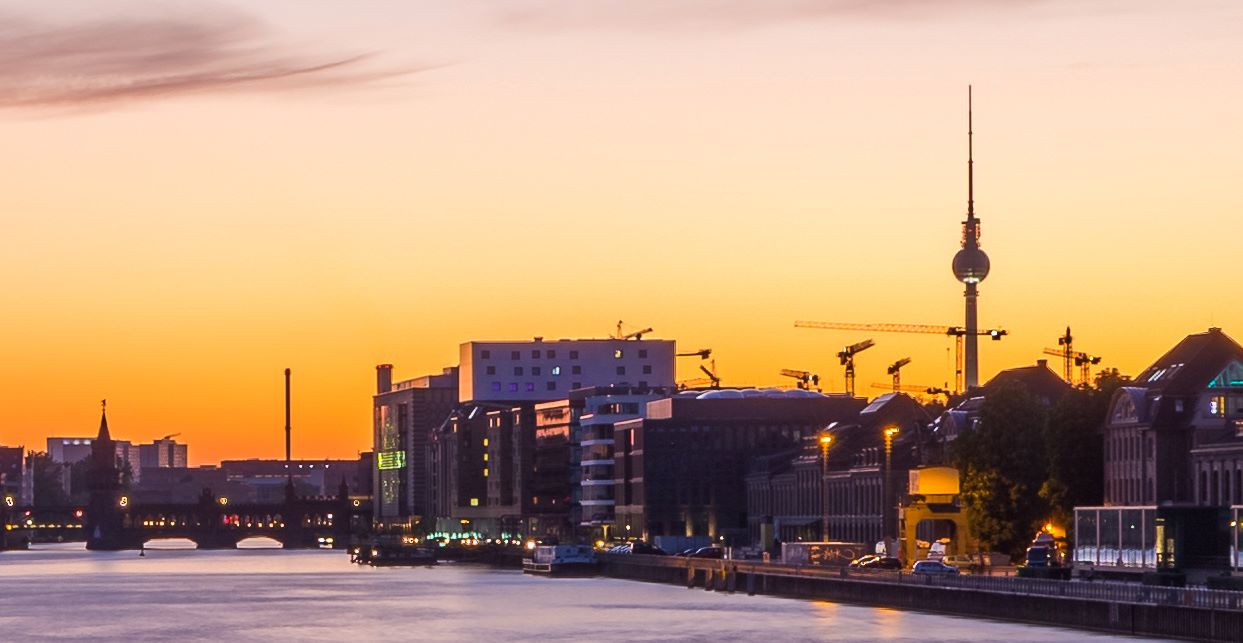
West Berlin has indeed been transformed since the war. There are still vacant lots and derelict properties, just as there are in London and Paris, but the streets are bustling and full of people. Someone at the office told him it is the only part of Germany without conscription and so has become very popular with the young. It’s a 24-hour city with clubs and bars that stay open deep into the early hours of the morning.
Muller’s premises prove to be close to Leopoldplatz in the French sector some way north of the station, and Peter has already checked into a hotel nearby. Now he waits in Muller’s austere reception, its high ceilings, elaborate chandeliers and dark wood-panelled walls discreetly carved with eagle motifs a stark contrast to the offices of Frobisher & Frobisher.
He is kept waiting just long enough to engender a level of impatience, and then a door opens and he is ushered in by a small man with jet black hair who introduces himself as Heinrich Muller and offers profuse apologies. Peter takes the armchair indicated, which would not have looked out of place in a museum, and gazes around the room, similarly clad in dark wood panelling and large enough to host a tennis match. Heinrich sits down on the opposite side of the desk, a mahogany affair surprisingly similar to that of Cavendish Frobisher but rather more at home. The only thing on the desk is a small cardboard box.
“Before we commence I do need to see your passport, as my secretary should have explained.”
“Of course,” said Peter, handing it over. “I also brought a rucksack, as she suggested.”
Heinrich glances at the small rucksack that Peter has placed on the floor besides his chair, turns his attention to the passport and then hands it back, “That all seems to be in order.”
He stands up and gently opens the box, lifting out a bundle of yellowing newspaper which he carefully unwraps. He places the content gingerly on the leather surface of the desk.
Peter’s first impression is of an almost garishly decorated red enamel egg, about eight centimetres from top to bottom. Heinrich sits back down and holds out his hand to Peter.
“Feel free to pick it up. Examine it at your leisure.”
Peter places it gently in his cupped hand, and as he does so the full beauty of the object becomes apparent. The red enamel is translucent and lightly covered in loops of gold and brightly sparkling stones. The filigree work is unusually fine: thin strands of gold cut to look like rope, and the stone mountings exquisitely detailed. The closer he looks the more he sees, and the more he realises what an extraordinary object he is holding.
“Are these diamonds?”
“Yes, they are rose-cut diamonds, and that is 24-carat gold. You’ll find it opens around the gold band in the middle. There’s a discreet hinge.”
Peter gingerly prizes it open to find another object nestling within a cream velvet lining. He tips it up to reveal a rosebud captured in yellow and green enamel just before it blooms. This too opens but there is nothing inside. He puts the rosebud back and closes the egg.
“It’s astonishing, but what is it?”

“What you are holding is a Fabergé egg: specifically, the Rosebud Egg that Nicholas II presented to his new wife Alexandra Feordorovna on the Easter after his father died, making him Tsar of Russia. If you look at the top you will see a tiny portrait of the Tsar, while the base displays 1894 which is the year Fabergé made it.”
Peter gently places the egg back onto the newspaper and sits back down. “It certainly is exquisite. I imagine it is worth a pretty penny?”
Heinrich leans back and smiles. He’s obviously enjoying himself.
“Ah. Value! Well that depends on two things, neither of them straightforward. There’s whether it’s the genuine item, and Fabergé eggs are amongst the most forged items you can find; and there’s whether it’s yours to sell. But ultimately, what it’s worth is what someone’s prepared to pay you for it: it’s what they believe that matters, not what you believe or even know to be true. Beauty is in the eye of the beholder, as they say.”
“OK … So is it genuine? Is it the real thing?”
“Hard to say. There are a number of tests. For example, Fabergé is supposed to have signed his more unique creations with a discreet ‘PCF’ motif. His given name was Peter Carl.”
Peter looks at the egg where it sits on the desk, “I didn’t see a signature, but I wasn’t looking for one.”
“I have looked, and there is no sign of a signature.” He laughs at Peter’s expression, “But don’t worry because that one is a hoax, put out by Fabergé himself shortly before his death to help identify forgeries. In my opinion, for what it’s worth, this is the genuine thing – this is the egg that the Tsar handed to his beloved wife, the granddaughter of Queen Victoria, on Easter Day as a symbol of his undying love.”
“Well, good, but how did it get into my father’s hands?”
“Exactly who is the rightful owner of this egg, or indeed any of the imperial Easter eggs, is again far from straightforward. They were made for the Tsar, so arguably belong to the Romanovs, but the whole family were locked in a cellar and shot by communist revolutionaries in 1918. The nascent Soviet government then confiscated their not inconsiderable treasures and proceeded to sell items off as it needed the money, mostly to dealers in the West. This particular egg ended up in London but the trail went dead sometime in the Thirties. I mean, owners tend to be discreet, unless they actually want to sell, as I’m sure you appreciate.”
“I can understand that.”
“And there are people who believe the eggs should be returned to their ‘rightful owners’, which usually means either the USSR, or for the more extreme, some branch of the Romanov family that they claim survived the shooting.”
“Right.”
“In truth, given the ambiguity, no serious buyer would be that concerned about rightful ownership. They would just want to own the thing.”
“OK. So, given all that, how much is it actually worth?”
“Oh, I’m confident you could get a few million for it.”
“Deutschmarks?”
“Pounds.”
oOo
Peter exits the building in a state of turmoil, the egg in its cardboard box sitting at the top of his rucksack like a ticking timebomb. Yes he could keep it, and it is certainly an exquisite item, but to keep it would be to endorse whatever his father had done to obtain it. On the other hand he could sell it, and it would certainly make a pretty penny, but in truth he already has everything he needs, or at least everything that money can give him, and selling would inevitably involve questions about its origin. No-one is going to pay for something like this without at least some assurance that they are to become its rightful owner, no matter what Muller might say, and that’s not somewhere he cares to go. Perhaps he should just place it in the nearest litter bin and walk away.
He starts down Mullerstrasse in the direction of his hotel but stops after just a short distance. After all, it’s probably only ten minutes’ walk from here, and it was his family home – or at least the house he lived in through his teenage years. He hadn’t planned to visit, but now he is here perhaps he should. He turns round and walks back up the street. Before long he knows the way without the help of a map.
A short time later he turns a corner and there it is, just across the street. It’s not quite as he remembers – it’s been over thirty years, after all – but it’s not been turned into a shop or an office block. It’s still recognisable as his old home, although as he approaches he sees a panel of doorbells. In his mind’s eye he can see himself bounding up the steps after school, into the hall with its high ceilings, chandeliers and dark carpets, and up the stairs to his bedroom on the third floor. He can see himself sitting on the window ledge playing with his soldiers and watching the passers-by.
He takes a step towards the house, wondering if he might have a look inside, but just as he’s about to cross the road he sees a woman exiting the building. She’s young and pretty and wearing a bright summer dress under a wide-brimmed straw hat, and she seems to be in some distress. As he gets closer he realises that he has seen her before: she is the woman who sat opposite him on the train. He stops in front of her.
“I’m sorry, but are you alright?”
She looks up and squints, as though she’s having trouble seeing him, “Yes! Sorry. I’m OK. It’s just that I’ve had a bit of a … shock” Then her eyes focus on his and her expression turns to confusion, “Do I know you? Sorry, but you seem familiar.”
He smiles back, “Well, yes. We sat opposite each other on the train from Hamburg. You spent the whole time buried in a book, so you might not remember me.”
She returns his smile, “Yes, I do remember now. You offered to help me with my case but I was rude and hurried off. I do apologise.”
“No apology necessary. Are you OK, though? You did seem rather upset when you came out of that … building.”
“Yes. No, I’m OK. It’s just that the building has some history for me, or rather with my family. It’s a long story.”
“Maybe made easier by the telling.” He looks at his watch for no reason other than to gather his thoughts. “Look, I’m alone and I’m not doing anything this evening. Do say if I’m being presumptuous, but are you free for an early dinner?”
She looks at him for a moment and then says, “Yes, I’d love to.” She holds out her hand, “My name is Rebecca.”
He takes it and gives it a firm shake, “… And I am Peter. Now, let’s see if we can find somewhere half decent to eat around here.”
They set off down the street.
“So are you here by yourself?” Peter asks.
“Yes, although I’m staying in a hostel and I’ve already made some friends.”
“Sounds like you’re enjoying yourself – apart from whatever happened just now, that is.”
“Well, yes. I mean, it really is a wonderful city! Last night I went out with a few of the girls from the hostel. We started off in a bar that served pretty good food, and then around eleven we moved on to a disco where we danced until about three, and then we ended up in this kind of tea house where we had tea and cakes. I mean, London shuts down about eleven, except for a bunch of seedy clubs, and there I was having afternoon tea at four in the morning!”
Peter can’t help but smile at her enthusiasm. “Yes, it really is an exceptional city.”
“But what about you? What are you doing in Berlin?”
“Nothing so interesting I’m afraid. I’m here on business and due back in Hamburg tomorrow.”
Rebecca is about to ask more when Peter interrupts.
“What about here?” He indicates a restaurant that’s come into view just up ahead. It looks modern and spacious with big picture windows and circular tables tucked into upholstered alcoves.
“It looks expensive …”
“Don’t worry about that.” He smiles, “Business is good.”
oOo
A smartly dressed waiter ushers them to a table next to a window that overlooks the street. The place is almost empty with its elegant décor and tastefully subdued lighting, and the street outside is quiet and bathed in a soft evening light. They put their rucksacks on the floor between them and sit down. Rebecca indicates she would like some white wine so Peter scrutinises the wine list, suggests a good vintage Riesling and orders a bottle. They peruse the menu for starters and a main course. Peter goes for steak “medium rare” while Rebecca picks out Wiener Schnitzel: “After all, I’ve got to try it sometime, and this place looks like they might know how to make it.”
Once the waiter has brought over the wine, filled their glasses and departed, Peter turns to Rebecca.
“So, perhaps you should tell me your story. What was it about that building that upset you so?”
She takes a sip and savours the taste before replying: “It was our family home, before the war. But Berlin was not a good place to be Jewish in the 1930s.”
“No, it wasn’t.”
“My grandfather built up a book business and had three or four shops in Berlin. Business was good and he was thinking of expanding, but then the Nazis came and we lost it all … the house, the business: everything. It all happened before I was born, but I still found it distressing to actually see the place.”
Peter listens as Rebecca tells him her family’s story, her eyes downcast but occasionally looking up, unsure whether to continue. Each time he smiles his encouragement so she continues until finally they sit in silence. Eventually Peter reaches out and touches her hand where it rests on the table between them.
“I can understand it would have been tough, going into that house after all this time, knowing what you know.”
“It was. My aunt Mimi showed me photos taken back then, photos of the interior and happy people having parties. I tried the doorbells and eventually this guy with a flat on the third floor let me in and showed me round. He showed me this room, his bedroom now, which overlooks the street. I recognised it from the pictures. There’s a photo of the exact same room with a little girl sitting on the bed and smiling up at the camera. The girl is Mimi and the photo was taken just before they fled to New York.”
Peter says nothing but in his mind’s eye he too can see the room with its high ceiling and ornate picture rail, and the broad windowsill. Gently he eases the conversation towards more pleasant subjects. She is easy to talk to and by the time they’ve polished off dessert they’re almost giggling. There’s an invigorating awkwardness and a feeling of anticipation as they finish coffee. Rebecca pushes her chair back and stands up.
“I’m just going to ‘powder my nose’, as they say. Back in a minute.”
“Yes of course. I’ll get the bill.”
He watches her as she makes her way through the tables to the restrooms and then signals the waiter. He sits back, thinking of the room that Rebecca had described. His father had moved them into that house when he was about ten or eleven. His father had just been promoted and he can remember him standing in their new living room, resplendent in his new uniform and surrounded by colleagues toasting his success. He had wondered how they had come by such a fine house but he hadn’t given it much thought at the time. It was all a big adventure. He had just joined the Hitler Youth, not particularly by choice but he did enjoy the camping trips and the activities like archery and canoeing. He hadn’t really thought about Jews at all. He just accepted what his parents told him; that they were some sort of problem that needed a solution.
One thing he does remember is opening his wardrobe for the first time and finding all these clothes hanging there that could only belong to a little girl. His mother had refused to answer when he asked and had got quite angry when he persisted with his questions. The next time he looked they were gone.
Years later he had dug deeper. He discovered that the promotion had been to the HTO, an organisation whose headquarters were in Berlin. Its purpose was ‘Aryanisation’, a polite word for the confiscation of Jewish property and its redistribution to members of the Aryan race, such as his own family. His father may not have directly ordered the ruin and death of so many of Rebecca’s family, but he had certainly been part of the process and, if the egg is anything to go by, an enthusiastic beneficiary. Exactly how he had escaped Nuremberg was not clear but he had kept a low profile ever since.
Rebecca returns a little later, her eyes shining as she shimmies her hips like she’s doing the twist.
“Would you like to go on somewhere? Perhaps you dance? We could find a club?”
He would dearly love to, and then perhaps back to his hotel followed by tea and cake at four in the morning. He glances at his watch, although the time is immaterial.
“Look, I would love to, I really would, but I’m afraid I’m going to have to turn you down. I’ve got a business call coming shortly at my hotel that I can’t miss, and then I’m on the first train back to Hamburg.”
She looks crestfallen. He fumbles through his pockets and brings out a notepad and a pen. He opens the notepad to a fresh page and hands them to her.
“Look, why don’t you write down your address? I’m often in London on business and we could easily meet up and make a proper night of it. It’s been a lovely evening and I really would like to see you again.”
She smiles back at him in a conspiratorial fashion, writes down her address and phone number and hands the pad back. He settles the bill, brushing aside her offers to contribute, and they walk out of the restaurant. She reaches up and gives him a lingering kiss on his cheek, and then walks off.
oOo
Rebecca rings Mimi as soon as she returns to England and arranges to visit even before going home. She sounds breathless and refuses to answer any questions until she gets there. Mimi lets her in when she arrives and takes her into the dining room, sitting her down at the table and bustling off into the kitchen to make a pot of tea before Rebecca can say anything. She returns to find that Rebecca has placed a cardboard box on the table between them.
“So what is this? And how are you? What’s going on?”
In a breathless tone Rebecca tells Mimi about her visit to the house in Berlin and her dinner with Peter.
“And then after, well I got back to the hostel feeling a bit deflated – I mean, we really had got on very well – and then, once I had the room to myself I started unpacking my rucksack and found this pushed down near the bottom. I mean I’d put the rucksack down at the restaurant, on the floor between us. He must have slipped it in when I went to the toilet.”
“But what is it?”
“Open it up, Mimi, and you’ll see.”
Mimi pours out the tea and hands Rebecca a cup. Then she opens up the box and lifts out its contents. She starts to unwrap the newspaper and then gasps, her hand going up to her mouth in shock. Rebecca looks down at the egg with its red enamel and diamonds sparkling in the light that filters through Mimi’s net curtains.
“It’s quite something, isn’t it? I’ve no idea what it actually is, but it must be worth a great deal … but what is it, Mimi? Are you alright?”
“Yes, child, I’m OK. It’s just that … well … I have seen this before, but it was a long, long time ago.”
She staggers to her feet and makes her way to the dressing table. She rustles through the drawers and eventually pulls out a magnifying glass. Then she goes to the mantlepiece and returns with one of the photographs. It is the one that shows her mother leaning against the mantlepiece in their house in Berlin. She peers at it through the magnifying glass and then hands them over to Rebecca.
“Have a look at the ornaments on the mantlepiece and I think you’ll see what I mean.”
Rebecca scans the ornaments through the magnifying glass. There, indistinct but clearly visible, is an egg, sitting in a wire structure on the mantlepiece. Rebecca looks at the egg on the table, and then back at the object in the photo. They are clearly one and the same.
“But what does this mean?”
“I don’t know, but I do wonder if it is purely coincidence that Peter happened to be there just as you came out of the house. Did he say anything about that?”
Rebecca thinks back over what she remembers of the conversation between Peter and herself as they had walked down the street, and then across the table in the restaurant.
“Well, no. In fact when I think about it he didn’t tell me much about himself at all. He’s some sort of businessman, but that’s about all he told me.” She looks up at her aunt, “We just clicked, that’s all. It didn’t seem important at the time and I was just glad to have someone to talk to.”
“Did you get his address?”
“No, but he took mine and said he’d get in touch next time he’s in London.”
Mimi smiles at her and picks up the egg. She opens it up and takes out the rosebud.
“I used to want to play with this when I was a kid, but my mother would never let me. She would tell me that it once belonged to the Tsar of Russia, and that he’d given it to his darling new wife on Easter Day. I’ve no idea how our family got hold of it, but it seems to have come back to us.”
Rebecca picks it up and places it on Mimi’s mantlepiece.
“And this is where it belongs.” She sits back down and they finish their tea.


 Another Roadside Attraction